You train hard. You log the kilometres, track your splits and push through the sessions when motivation is low. Whether you run or cycle, you are committed. But no matter how consistent you are with your main sport, there is a good chance your body is quietly working against you. Tightness in the hips. Weakness in the glutes. A core that switches off the moment fatigue sets in. These are not signs of poor fitness. They are the predictable result of repetitive, single-plane training. And they are exactly what reformer pilates at CRUSH Studios is built to fix.
The hidden cost of repetitive sport
Running and cycling are both linear sports. Every stride, every pedal stroke moves you forward in the same plane of motion, recruiting the same muscles in the same pattern, again and again. That repetition is what makes you efficient at your sport. It is also what creates the imbalances that hold you back.
Runners typically develop tight hip flexors, weak glutes and poor lateral stability. The knees track inward, the pelvis drops with every stride and the lower back starts absorbing forces it was never designed to handle. The result is slower times, reduced efficiency and eventually injury.
Cyclists face a different but equally predictable set of problems. Hours in a flexed, forward-leaning position shortens the hip flexors, rounds the upper back and creates chronic tightness in the neck and shoulders. Off the bike, the body struggles to fully extend. Power transfer suffers and the risk of overuse injury climbs.
Reformer pilates does not replace your sport. It corrects the imbalances your sport creates. Read our blog about how pilates improves your performance in other sports for a broader look at how this works across different disciplines.
What the reformer does for runners
Core strength that holds under fatigue
A strong core is not about a flat stomach. It is about the deep stabilising muscles that keep your pelvis level, your spine neutral and your running form intact when your legs are screaming at kilometre thirty. These are the muscles the reformer is specifically designed to activate.
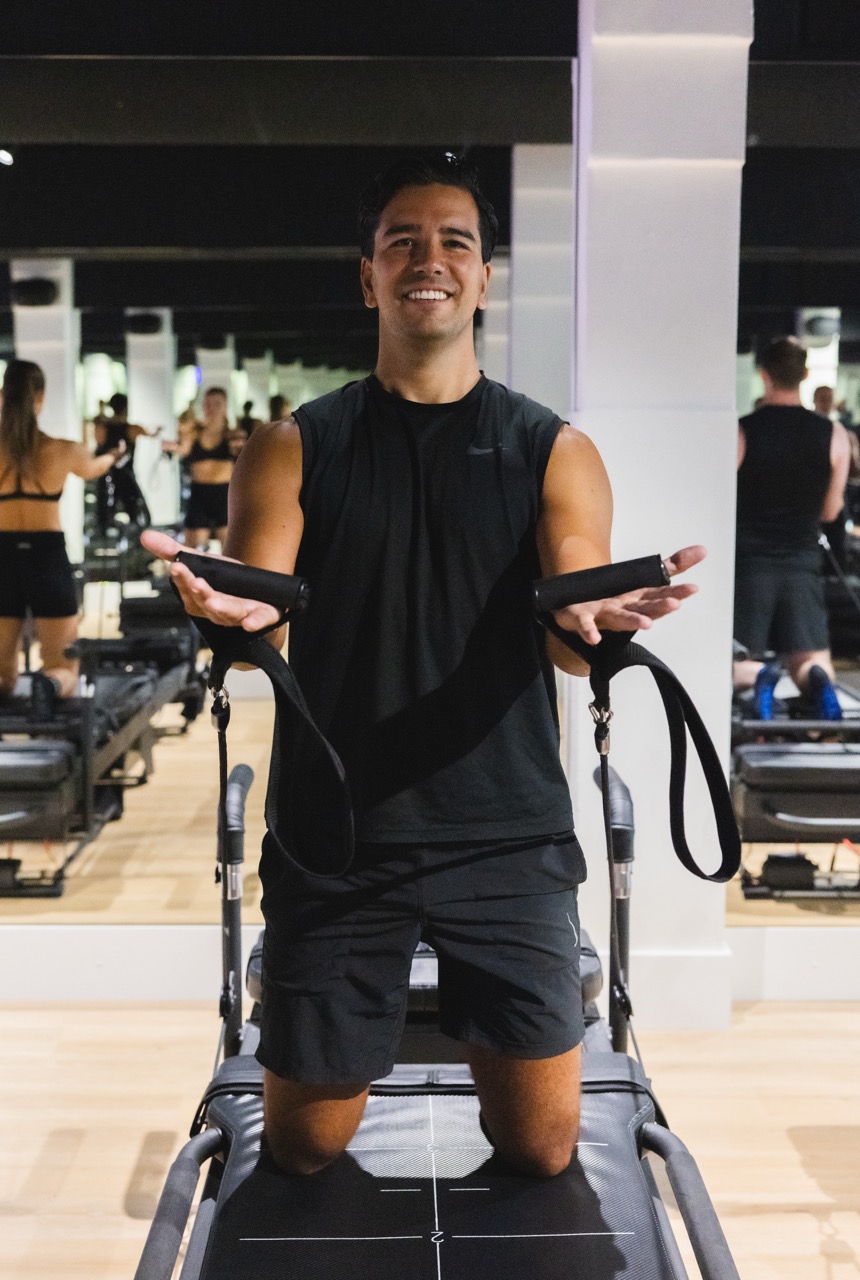
At CRUSH, every reformer class builds this deep core stability through controlled, spring-loaded resistance. The sliding carriage constantly challenges your body to stabilise, recruiting the exact muscles that protect your spine and power your stride.
Glute activation and hip stability
Weak glutes are one of the leading causes of running injuries. When the glutes do not fire properly, the knees collapse inward, the IT band tightens and the lower back overloads. The reformer targets the glutes and hip stabilisers in ways that running itself never does, building the strength that keeps your form together from the first kilometre to the last.
Mobility without losing stability
Tight hip flexors limit your stride length and force your lower back to compensate. The reformer opens the hips through full, controlled range of motion while simultaneously building the strength to support that mobility. You become more flexible and more stable at the same time, which is exactly what efficient running requires.
“I started CRUSH alongside my marathon training and noticed the difference within three weeks. My hips felt more open, my posture improved and I stopped getting that familiar tightness in my left knee. I wish I had started years ago.” — CRUSH member, marathon runner
What the reformer does for cyclists
Counteracting the cycling position
The cycling position is the enemy of good posture. Hours of forward flexion tightens the chest, weakens the upper back and shortens everything at the front of the body. Reformer pilates directly counters these patterns by opening the chest, strengthening the posterior chain and restoring the body’s ability to fully extend.
The result is less pain on and off the bike, better breathing capacity and a more powerful, efficient position in the saddle.
Power transfer through a stable core
Every watt you produce on the bike has to travel through your core before it reaches the pedals. A weak or unstable core is a leaky pipe. Energy gets lost in compensatory movements instead of going where it needs to go. Strengthening the deep core through reformer pilates means more of the power your legs generate actually reaches the road.
Injury prevention for the long season
Cyclist’s knee, lower back pain and neck strain are among the most common complaints in the sport. All of them are linked to the imbalances and postural patterns that cycling creates over time. Regular reformer pilates addresses the root causes rather than the symptoms, keeping you on the bike and out of the physio’s office.
“As a cyclist I was always dealing with lower back issues after long rides. Two months of CRUSH classes completely changed that. My back is stronger, my position on the bike feels more natural and my power numbers have actually improved.” — CRUSH member, competitive cyclist
Why CRUSH works for athletes
The CRUSH method is low-impact but high-intensity, which makes it the perfect complement to the high training loads that runners and cyclists already carry. You get a genuine workout that drives real adaptation without adding stress to joints and tissues that are already under pressure from your sport.
The spring resistance of the reformer creates constant tension throughout every movement, activating more muscle fibres in less time than conventional gym training. The instability of the carriage recruits the deep stabilising muscles that sport-specific training misses. And the full-body nature of each 50-minute class means no muscle group gets left behind.
Want to understand more about the science behind this? Read our blog on why springs beat weights for a deeper dive into how the reformer creates results that conventional training cannot.
How to fit CRUSH into your training week
Two CRUSH sessions per week alongside your regular sport training is the sweet spot for most athletes. Use them on lighter training days or as active recovery after hard sessions. The low-impact nature of the reformer means you can train at CRUSH without compromising your running or cycling performance.
Consistency is what makes the difference. Read our blog about why consistency is more important than intensity to understand why two regular sessions will always outperform sporadic effort.
Check the CRUSH schedule and find slots that work around your training. New to CRUSH? Start with our intro packages and experience the difference the reformer makes in your very first session.
Burn. Shake. Smile. CRUSH.