Walk into any conventional gym and you will find the same equipment that has been there for decades. Barbells, dumbbells, cable machines, treadmills. They work, to a degree. But there is a reason elite athletes, physiotherapists and movement specialists around the world have turned to the reformer as one of the most effective training tools available. The science behind it is compelling, and once you understand it, the results you feel at CRUSH Studios start to make a lot more sense.
How conventional weights work
When you lift a dumbbell or push a barbell, you are working against gravity. The resistance is fixed, the direction is always downward and momentum plays a significant role. At the top of a bicep curl, for example, your muscle is barely working because gravity is no longer pulling the weight away from you. At the bottom, momentum from the swing does much of the work for you.
This means that with conventional weights, your muscles are only truly challenged at certain points in the range of motion. The rest of the movement is partially wasted. For building bulk, this can still be effective. For building functional strength, stability and the kind of deep muscle activation that changes how your body moves and feels, it falls short.
How the reformer works differently
The reformer uses a system of springs to create resistance. Those springs behave very differently from gravity. Spring resistance increases as the spring stretches, which means the further you move into a position, the more resistance you feel. But more importantly, the springs create resistance in multiple directions, not just downward.
Constant tension throughout the movement
Because the springs are always pulling or pushing against your movement, your muscles are engaged throughout the entire range of motion. There is no resting point, no moment where momentum takes over. Every millimetre of every exercise requires muscular effort. This is called constant tension training, and it is one of the most efficient ways to build strength and muscle tone.
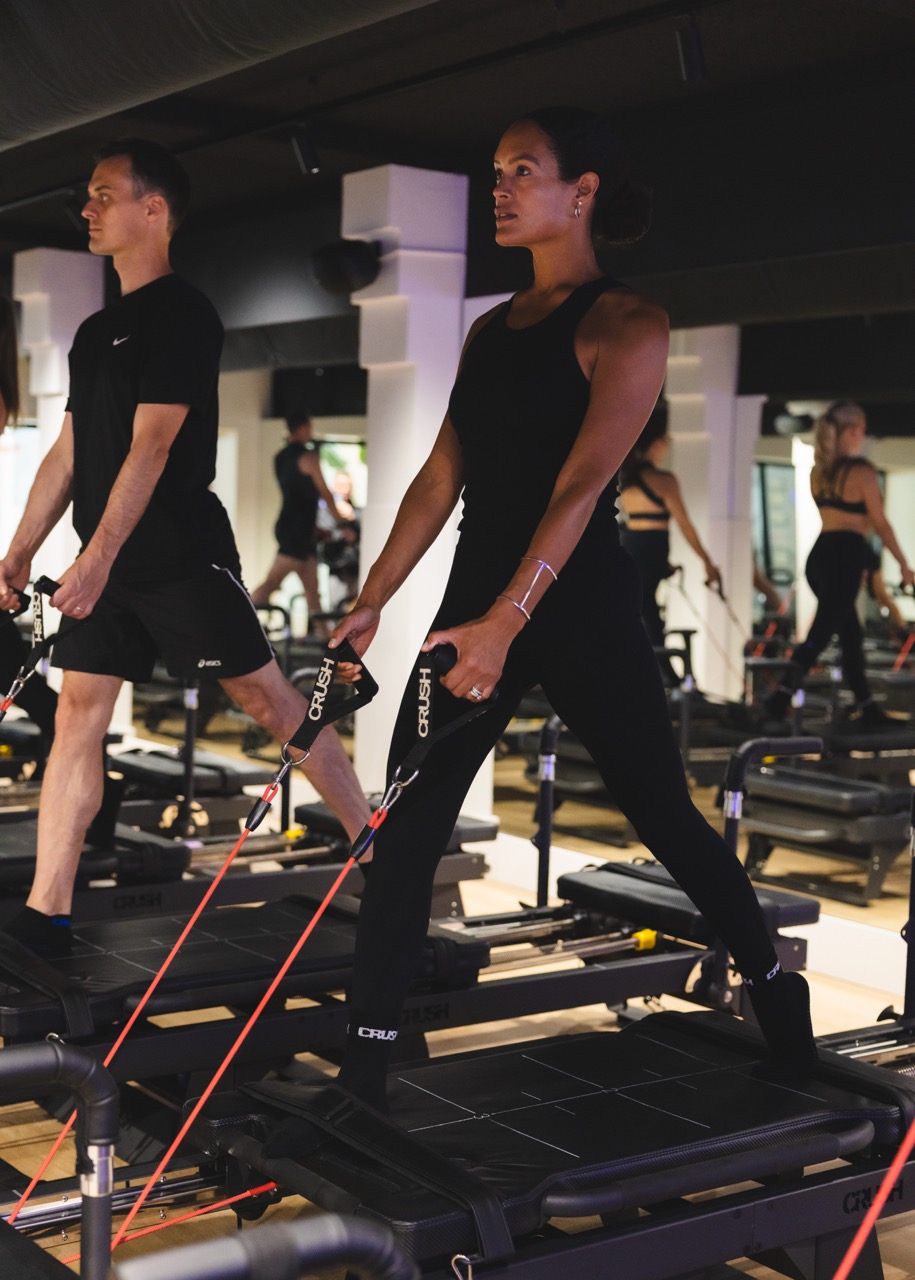
At CRUSH, this principle is built into every exercise in the High Intensity Reformer class. Whether you are pushing the carriage away or controlling it back, your muscles are working. The result is more total muscle activation in less time.
Eccentric loading
One of the most valuable aspects of spring resistance is what happens on the return phase of a movement. When you push the carriage out and then control it back, the springs are pulling it back toward the starting position. Your muscles have to resist that pull, working eccentrically to slow and control the movement.
Eccentric muscle contractions are where a significant portion of strength and muscle development happens. Research consistently shows that eccentric loading produces greater strength gains and more muscle fibre recruitment than concentric loading alone. With conventional weights, you can choose to let gravity do the work on the return. With the reformer springs, you cannot. The resistance is always there, in both directions.
Multi-directional resistance
Gravity only pulls in one direction: down. The springs of the reformer can be configured to pull from the front, the back or at an angle, depending on how the exercise is set up. This allows the reformer to challenge muscles in planes of movement that free weights simply cannot replicate. Rotational strength, lateral stability and diagonal movement patterns are all trainable on the reformer in ways that transfer directly to real-life movement and sport.
The instability factor
Beyond the springs, the sliding carriage of the reformer introduces an element of instability that is absent from most gym equipment. Every time you push or pull the carriage, your body has to stabilise against the movement. This recruits the deep stabilising muscles of the core, hips and shoulders that conventional training rarely reaches.
These are the muscles that hold your body together during complex movements. They protect your joints, maintain your posture and make everything else you do more efficient. Strengthening them through reformer training does not just make you better at pilates. It makes you better at everything. Read our blog about how pilates improves your performance in other sports to see exactly how this translates outside the studio.
Why low-impact does not mean low-intensity
One of the most common misconceptions about the reformer is that because it is gentle on the joints, it must be easy. The opposite is true. Because the springs create constant tension and the carriage demands constant stabilisation, the muscular effort required in a CRUSH class is genuinely high. Your heart rate rises, your muscles fatigue and you leave the studio having done serious work.
The difference is that this intensity is achieved without the joint stress that comes from heavy lifting or high-impact cardio. No compression on the knees, no shear force on the spine, no impact on the ankles. The reformer delivers intensity through resistance and control rather than through load and impact. This is why it is suitable for rehabilitation, for beginners and for elite athletes at the same time.
Want to understand this principle in more depth? Our blog about why low-impact high-intensity training is so effective breaks it down further.
The CRUSH reformer: built for results
At CRUSH we work with a custom-designed reformer specifically built for the CRUSH method. Every class is structured to maximise the benefits of spring resistance, from the sequencing of exercises to the spring settings used at each stage of the workout. Nothing is accidental. Everything is designed to get the most out of every minute you spend in the studio.
Whether you are new to the reformer or have been training for years, the science works the same way. The springs create the stimulus, your body adapts and the results follow. All you have to do is show up consistently. Check the CRUSH schedule and book your next class, or explore our intro packages if you are ready to experience the reformer for the first time, and check Reformer Pilates for more information.
Burn. Shake. Smile. CRUSH.